The conference convened 26 early-career researchers, healthcare professionals, and policymakers to discuss strategies to strengthen health systems and address Non-Communicable Diseases (NCDs) and Neglected Tropical Diseases (NTDs).
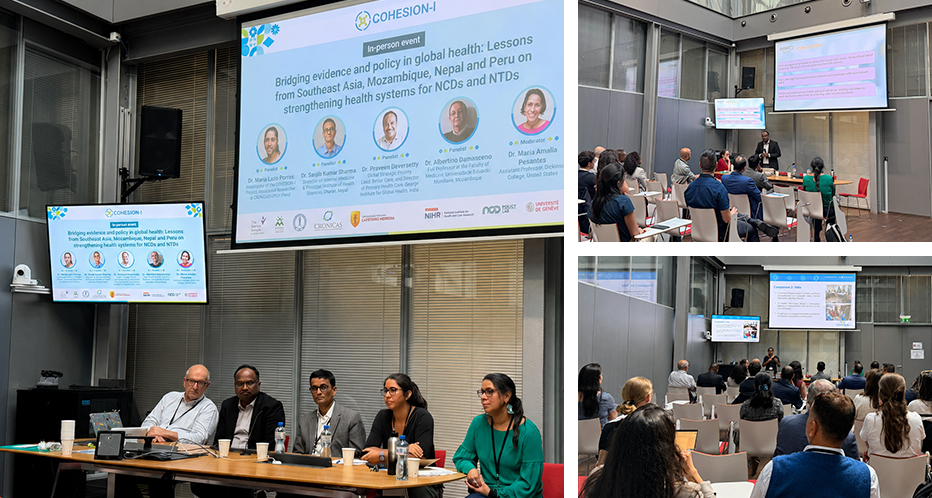
On June 11 2026, the NCD Policy Lab at the University of Geneva and the COHESION-I Project hosted an in-person conference at Campus Biotech in Geneva, Switzerland.
The in-person event brought together an internationally diverse panel of experts to share experiences and lessons on strengthening health systems and addressing Non-Communicable Diseases (NCDs) and Neglected Tropical Diseases (NTDs) across the Global South.
Community-based approaches were a recurring theme during the presentations, with panelists stressing the value of context-specific interventions and local engagement across India, Mozambique, Nepal, and Peru.
The conference opened with an overview of the COHESION Project, from formative research and co-creation in Phase I to the COHESION-I Project in Phase II, which comprises two components: the co-design, implementation, and evaluation of interventions; and the optimization process in India.
The presentation on Nepal emphasized the importance of introducing innovations within health systems, particularly in addressing the burden of NCDs and NTDs. Topics included community-based and clinical strategies to reduce snakebite-related mortality, integrated approaches to managing kidney disease, hypertension, diabetes, and cardiovascular disease, and ongoing efforts to translate research evidence into practice.
Experiences from Mozambique were also highlighted, focusing on shaping the local chronic disease agenda and turning evidence into action. Drawing from the regional perspective on hypertension as a public health challenge, discussions also explored how evidence-based approaches can inform strategies for NCD prevention and control.
The session also explored lessons from Indonesia, including the scaling up of a community-based cardiovascular disease prevention program at the primary healthcare level. Central to this experience was SMARThealth, a mobile-enabled digital platform that supports healthcare workers with tools to improve clinical decision-making, screening, referral, and access to NCD care.
Engaging participants in a Q&A session with the panelists further reinforced key lessons on adapting and scaling context-specific approaches to strengthen health systems across diverse settings. We sincerely thank all participants for their valuable contributions, and the NCD Policy Lab team at the University of Geneva for hosting this event.