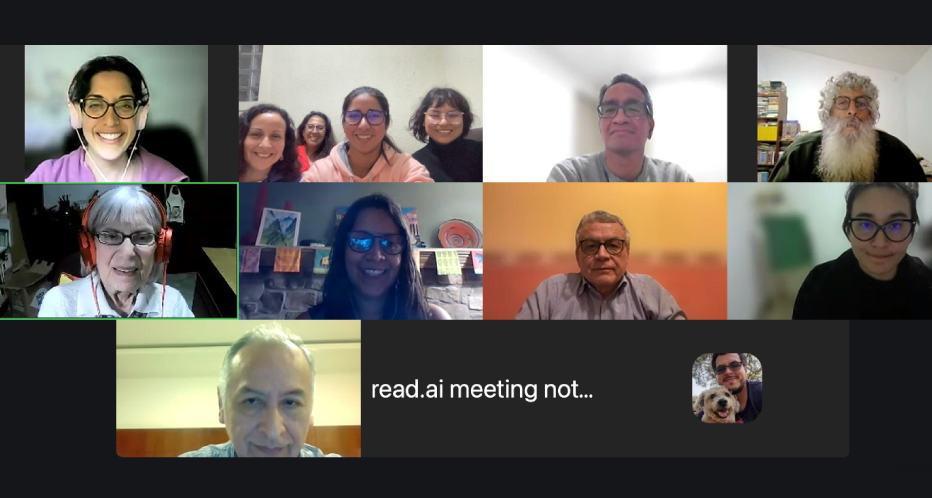
The second virtual meeting of the National Advisory Board in Peru was held on Wednesday, August 7th. Two primary objectives were discussed: progress on the co-design phase and integrating Advisors’ recommendations into the study implementation and evaluation protocol.
The COHESION-I Project (2022-2026) has two components. The first component, which takes place in Mozambique, Nepal, and Peru, comprises intervention co-design processes and their subsequent application and evaluation in each country. The second component is an optimization process carried out in India, encompassing replicating the methodologies implemented in COHESION (2016-2020) and COHESION-I (2022-2026) in selected settings (read more here: https://rb.gy/2ch8pk).
The second meeting of the National Advisory Board in Peru focused on the co-design process in this country. During the meeting, participants were reminded about the objectives of this participatory process. By fostering dialogues and participation among various stakeholders in the healthcare system, the co-design process builds and defines the interventions to be implemented by the COHESION-I Project. This process also seeks to motivate stakeholders to partake in the different phases of the project. This could help increase ownership and long-term sustainability of implemented interventions and their outcomes.
During the meeting, the research team shared progress in the intervention’s co-design process. The National Advisory Board members provided recommendations to improve the intervention components. For example, regarding the capacity-building program for health workers, they emphasized the importance of having a horizontal space where training could break hierarchical differences among healthcare providers and between healthcare providers vs patients. COHESION-I is working to create a methodology that addresses differences between stakeholders to break down these barriers in the same training. The research team members involved in the co-design process indicated these hierarchical differences were not so visible during the workshops. During the meeting, the Advisors were informed about how their recommendations for the Implementation and Evaluation protocol were integrated. Lastly, along the conversations, meeting participants also exchanged other ideas such as how the project addresses gender issues, particularly sexism, and its impact on both women and men. In addition, it was recommended that it would be important to create a capacity-building program that is sustainable over time and that considers the different problems faced at the different levels of the health system.
We extend our sincere thanks to the National Advisory Board members for their attendance and valuable contributions, which continue to enhance the COHESION-I Project in meaningful ways.